

Engineered by FTI. Runs anywhere Debian 13 runs.
IBeX4 is the fourth generation of IBeX. It combines Debian 13 Linux tuned for real-time voice, an Asterisk-based call engine that FTI has structured, extended and tested for over twenty years, and FTI’s own management tools.
How IBeX4 is built
What is IBeX4 built on?
Debian 13 and a call engine based on Asterisk 22. FTI uses Debian packaging to modify the operating system, and the kernel where necessary, so every change is versioned, tested and repeatable.
Stripped to the essentials
Everything that isn’t needed to handle calls is removed. There is no database and no heavy web interface, which means fewer moving parts, a smaller attack surface and more of the system dedicated to calls.
How is it different from a standard Asterisk install?
Asterisk on a generic server is a toolkit. IBeX4 is a finished product: a minimal, tuned operating system and call engine, integrated and tested together, updated as a whole, and supported directly by the developer.
How are updates delivered?
As IBeX packages (ibex-core, ibex-switch, ibex-switch-control and a platform package for your hypervisor) that pass through alpha, a structured beta and general release before reaching live systems, delivered automatically over the Internet.
The IBeX System Management Console
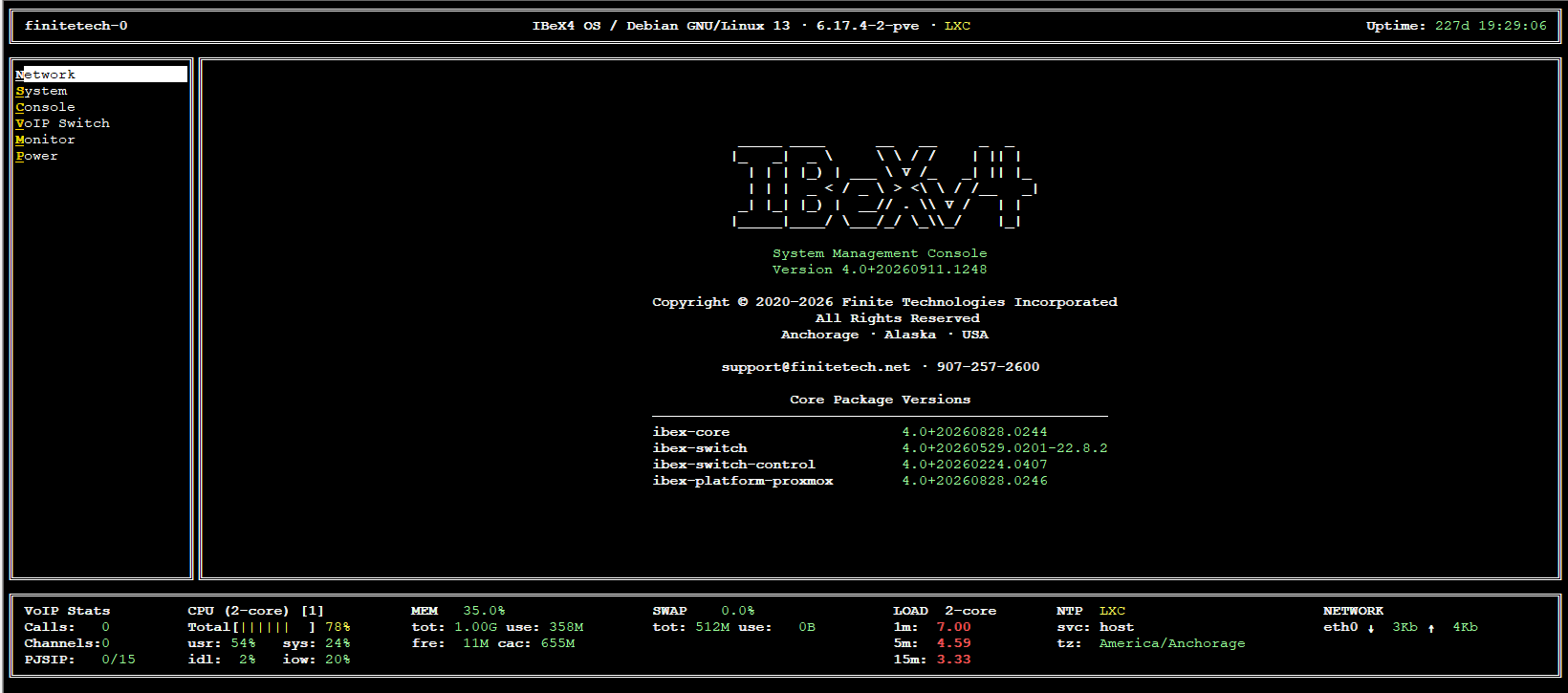
IBeX4 is managed from the IBeX System Management Console: a fast, text-based console for network, system, switch, monitoring and power settings, with live call, CPU, memory and network statistics. It runs over SSH or the system console, so it works anywhere, even on a slow connection.
What a hypervisor gives your phone system
Snapshots and backups
Take a snapshot before a change and roll back in minutes. Back up the whole phone system with the tools you already use.
High availability
Run standby instances on other hosts and fail over with your hypervisor’s clustering. FTI’s own IBeXc service runs on IBeX4 with N+2 redundancy, and you can go to whatever level you need. Standby instances are included in the licence.
Scale without new hardware
Add CPU, memory or storage to the virtual machine or container as you grow, or move it to bigger hosts without reinstalling. Tested to 8,500 simultaneous calls.
Four generations of IBeX
Finite Technologies is founded
FTI starts as a software company. Software has been the core of the company ever since.
IBeX development begins
FTI starts building its own phone system software on Linux and Asterisk.
IBeX version 1
The first generation of IBeX goes into production.
IBeX3
The third generation of IBeX launches.
IBeX4
The fourth generation installs anywhere Debian 13 runs: a virtual machine, an LXC container or a dedicated server.
Platform questions
Is IBeX4 open source?
IBeX4 is built on open-source foundations, including Linux and Asterisk, with FTI’s own proprietary modules, management tools and packaging on top. It is licensed commercially.
Can I upgrade from IBeX3?
Yes. FTI plans and carries out migrations from IBeX3, and IBeX3 customers receive a migration credit. Talk to us about timing.
How is IBeX4 managed?
From the IBeX System Management Console, a text-based console available over SSH or the system console, with Asterisk’s own command line available to administrators.
Want the technical detail?
Features, codecs, interoperability and system requirements are on the technical reference page.